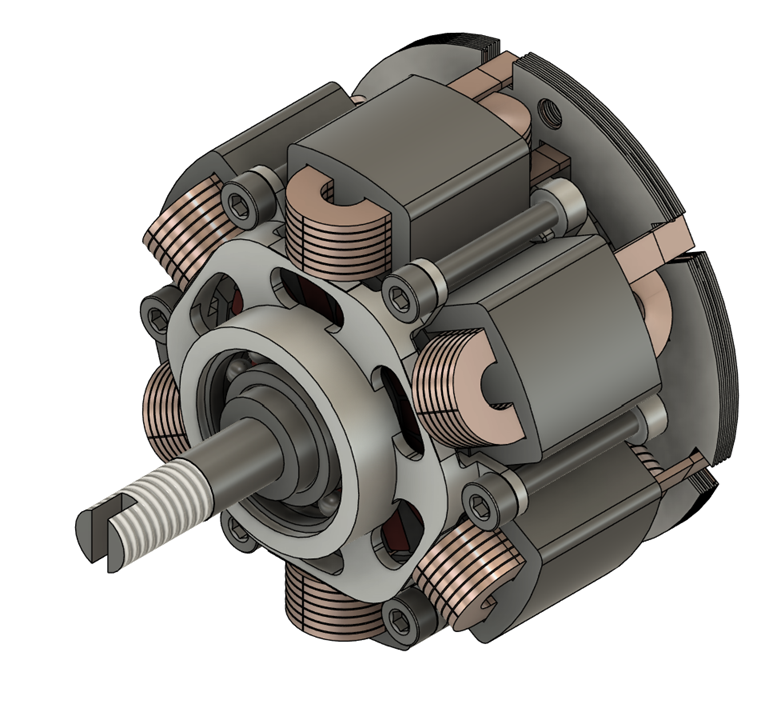
CIANO14 40_12 — Compact High-Torque Motor
€150
Engineering sampleHand-built and individually bench-tested.
Series price €60 — coming soon at production volume.
8 kW/kg — more than 3× the continuous power and thrust of any comparable 3115-class motor.
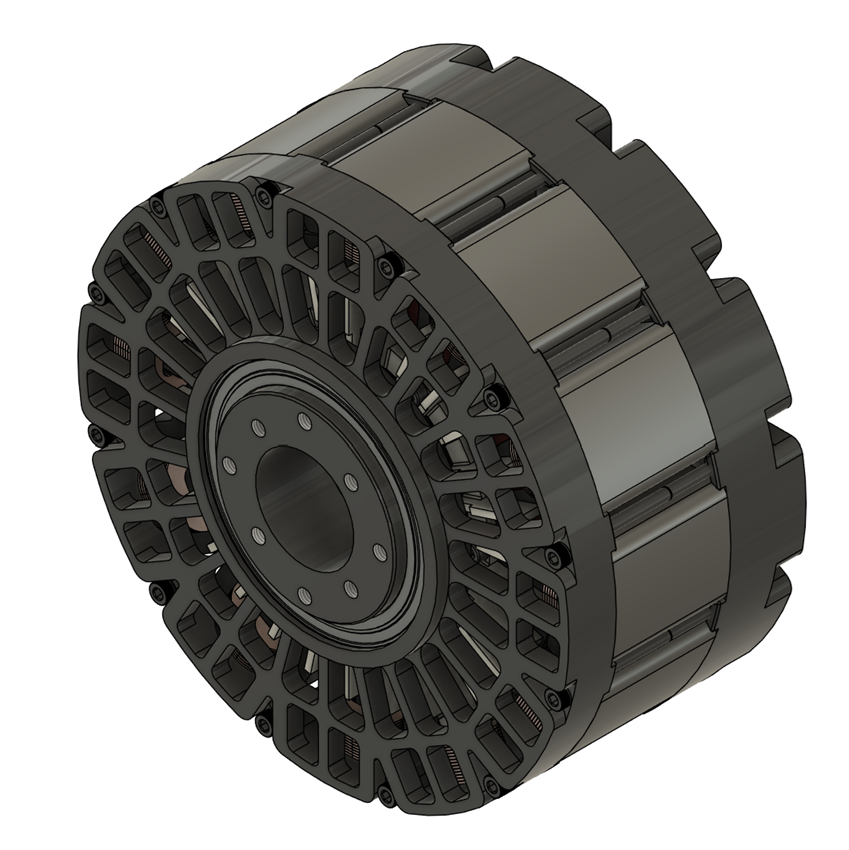
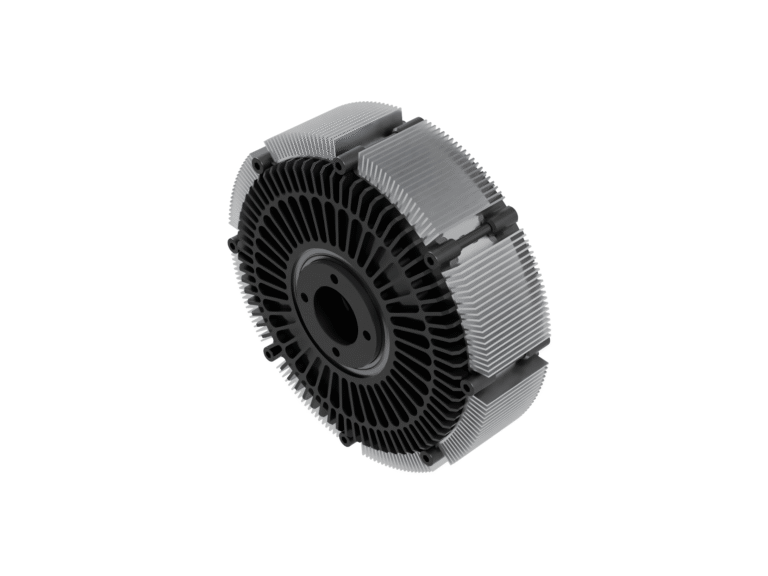
The CIANO14 40_12 is a compact precision motor built on the AeroStator Core platform. Tangential magnet polarization delivers exceptional torque density in a minimal footprint — ideal for racing UAVs and precision aerial systems.
Specifications
| Continuous | Peak | |
|---|---|---|
| Power | 1,038 W | 1,402 W |
| Torque | 0.56 Nm | 0.70 Nm |
| Thrust | 3,455 g | 4,304 g |
| Speed | 13,081 rpm | 14,524 rpm |
| DC current | 44 A | 62 A |
| Efficiency | 74.2% | 76.9% |
| Configuration | 14 Poles / 12 Slots | |
| KV | ~850 rpm/V | |
| Torque Constant (Kt) | 0.011 Nm/A | |
| Voltage | 15–25 V (6S LiPo) | |
| Cooling | Air | |
| Protection | Open frame | |
| Dimensions (D×L) | 40 × 47 mm | |
| Weight | 0.125 kg | |
| Max Temperature | 150 °C | |
| Warranty | 1 year | |
Applications
Racing drones, precision UAVs, light aerial robotics. Compatible with 10″–12″ propellers.
Why eMotres?
- ✓Patented construction — highest torque density on the market
- ✓1-year warranty on all motors
- ✓Custom motor design available (0.5 kW – 1 MW)
First propeller-dynamometer sweep of the CIANO14 40_12 on a 3-blade 10.5×5 (HQ1050) propeller at 24 V (2026-06-16) — system efficiency (motor + controller) holds a 75–77 % plateau to the top of the range while the winding stays cool. Hover any chart to read the values at each point.
| Throttle | RPM | V | A | Thrust (g) | Torque (N·m) | Temp (°C) | P elec (W) | P shaft (W) | Sys eff (%) | Thrust eff (gf/W) |
|---|---|---|---|---|---|---|---|---|---|---|
| 10% | 1,871 | 24.28 | 0.33 | 48 | 0.011 | 29.4 | 8.0 | 2.2 | 26.8 | 5.97 |
| 20% | 4,006 | 24.26 | 1.65 | 252 | 0.047 | 29.4 | 40.1 | 19.7 | 49.2 | 6.29 |
| 30% | 5,533 | 24.19 | 3.64 | 528 | 0.093 | 29.6 | 87.9 | 53.9 | 61.3 | 6.01 |
| 40% | 7,040 | 24.05 | 6.81 | 911 | 0.151 | 30.0 | 163.7 | 111.3 | 68.0 | 5.57 |
| 50% | 8,719 | 23.82 | 12.19 | 1,438 | 0.231 | 30.6 | 290.2 | 210.9 | 72.7 | 4.96 |
| 60% | 10,222 | 23.59 | 19.32 | 1,993 | 0.317 | 31.5 | 455.8 | 339.3 | 74.4 | 4.37 |
| 70% | 11,557 | 23.29 | 28.31 | 2,605 | 0.414 | 32.5 | 659.5 | 501.0 | 76.0 | 3.95 |
| 80% | 12,819 | 23.06 | 39.96 | 3,305 | 0.528 | 33.8 | 921.4 | 708.8 | 76.9 | 3.59 |
| 90% | 13,990 | 22.80 | 54.00 | 3,976 | 0.639 | 35.6 | 1231.2 | 936.2 | 76.0 | 3.23 |
| 100% | 14,524 | 22.66 | 61.89 | 4,304 | 0.696 | 38.0 | 1402.2 | 1058.6 | 75.5 | 3.07 |
System efficiency = shaft power / electric power — measured at the bus, so it includes the controller (motor + ESC), not the motor alone. Thrust efficiency = thrust / electric power. Peak system-efficiency point highlighted. Temperatures are from an automatic ramp (transient, not steady-state). Setup: Test bench LY-10KGF dynamometer · Propeller 10.5×5 (HQ1050) · 3-blade · ESC 80 A · Bus voltage 24 V · Ambient 31.3 °C / 74.7 % RH · Air pressure 100.70 kPa.
The same CIANO14 40_12 driven by a field-oriented (FOC / sinusoidal) controller on a 2-blade 10×4.5 propeller at 22 V (2026-07-09). Moving from trapezoidal BLDC to FOC lifts peak system efficiency to 84.2 % — about 7 points higher — across a smoother sweep. Hover any chart to read the values at each point.
| RPM | V | A | Thrust (g) | Torque (N·m) | P elec (W) | P shaft (W) | Sys eff (%) | Thrust eff (gf/W) |
|---|---|---|---|---|---|---|---|---|
| 1,935 | 22.11 | 0.38 | 55 | 0.020 | 8.3 | 4.0 | 47.5 | 6.54 |
| 3,087 | 22.09 | 1.02 | 177 | 0.042 | 22.6 | 13.7 | 60.5 | 7.84 |
| 4,159 | 22.08 | 2.11 | 348 | 0.071 | 46.6 | 30.7 | 65.9 | 7.48 |
| 6,215 | 22.04 | 6.20 | 822 | 0.163 | 136.6 | 105.8 | 77.4 | 6.02 |
| 7,078 | 21.98 | 9.06 | 1,078 | 0.213 | 199.1 | 157.9 | 79.3 | 5.41 |
| 7,936 | 21.93 | 12.78 | 1,381 | 0.279 | 280.3 | 231.4 | 82.5 | 4.93 |
| 8,467 | 21.90 | 15.64 | 1,579 | 0.325 | 342.4 | 288.3 | 84.2 | 4.61 |
| 9,963 | 21.74 | 26.29 | 2,254 | 0.456 | 571.6 | 475.2 | 83.1 | 3.94 |
| 10,825 | 21.62 | 34.60 | 2,703 | 0.547 | 748.1 | 619.5 | 82.8 | 3.61 |
| 11,601 | 21.48 | 44.24 | 3,088 | 0.628 | 950.3 | 762.1 | 80.2 | 3.25 |
| 12,260 | 21.32 | 54.23 | 3,412 | 0.702 | 1156.3 | 900.6 | 77.9 | 2.95 |
| 12,606 | 21.22 | 60.54 | 3,622 | 0.743 | 1284.6 | 979.6 | 76.3 | 2.82 |
System efficiency = shaft power / electric power — measured at the bus, so it includes the controller (motor + ESC), not the motor alone. Thrust efficiency = thrust / electric power. Peak system-efficiency point highlighted. Efficiency is system efficiency (motor + controller) = shaft power / electric power. This controller log has no temperature channel. This run differs from the BLDC run in more than the controller — different dynamometer (DET G10-10KGF vs LY-10KGF), propeller (2-blade 10×4.5 vs 3-blade 10.5×5) and bus voltage (22 V vs 24 V). The two are therefore separate data points, not a controlled A/B: neither the thrust nor the efficiency difference can be attributed to the controller alone. Setup: Test bench DET G10-10KGF dynamometer · Propeller 10×4.5 (1045) · 2-blade · Controller FOC (sinusoidal) · Bus voltage 22 V · Signal 50 Hz PWM sweep.
Benchmarked together with FOURnamics GmbH on their test bench, driven by their nCTRL ESC on a 2-blade AERONAUT 12×5 propeller at 6S (2026-08-12). Peak system efficiency (motor + ESC) reaches 93.6 % — the best figure measured on the CIANO14 so far — and max thrust climbs to 5,764 g. Hover any chart to read the values at each point.
nCTRL ESC by FOURnamics GmbH ↗
| Throttle | RPM | V | A | Thrust (g) | Torque (N·m) | P elec (W) | P shaft (W) | Sys eff (%) | Thrust eff (gf/W) |
|---|---|---|---|---|---|---|---|---|---|
| 10% | 2,240 | 24.50 | -0.10 | 135 | 0.073 | -2.0 | 17.0 | — | — |
| 20% | 4,126 | 24.50 | 1.30 | 489 | 0.135 | 33.0 | 59.0 | — | 15.00 |
| 30% | 5,924 | 24.50 | 4.20 | 965 | 0.212 | 103.0 | 132.0 | — | 9.40 |
| 40% | 7,529 | 24.50 | 9.10 | 1,581 | 0.301 | 222.0 | 237.0 | — | 7.10 |
| 50% | 9,108 | 24.50 | 16.00 | 2,314 | 0.412 | 393.0 | 393.0 | — | 5.90 |
| 60% | 10,309 | 24.50 | 24.00 | 2,964 | 0.510 | 588.0 | 551.0 | 93.6 | 5.04 |
| 70% | 11,498 | 24.50 | 34.40 | 3,728 | 0.633 | 843.0 | 762.0 | 90.4 | 4.42 |
| 80% | 12,532 | 24.50 | 45.70 | 4,430 | 0.745 | 1120.0 | 977.0 | 87.3 | 3.96 |
| 90% | 13,370 | 24.50 | 59.30 | 5,160 | 0.872 | 1454.0 | 1221.0 | 84.0 | 3.55 |
| 100% | 14,255 | 24.50 | 74.00 | 5,764 | 0.979 | 1813.0 | 1461.0 | 80.5 | 3.18 |
System efficiency = shaft power / electric power — measured at the bus, so it includes the controller (motor + ESC), not the motor alone. Thrust efficiency = thrust / electric power. Peak system-efficiency point highlighted. Full bench sweep shown. At light load (below 60 % throttle) the bench’s electrical-power channel under-read (P elec at or below shaft power), so system efficiency is not shown for those rows; the 60 % reading stays in the table but is left out of the efficiency chart as an outlier. Current is derived from electric power at the 24.5 V bus. Setup: Test bench FOURnamics test bench · ESC FOURnamics nCTRL (FOC) · Propeller AERONAUT 12×5 · 2-blade · Bus voltage 24.5 V (6S).